
Liminal Creatures
We may view the Now as a space to move through, escaping the past as we run toward the future. However, it is more accurate to say that it is a place we walk around.

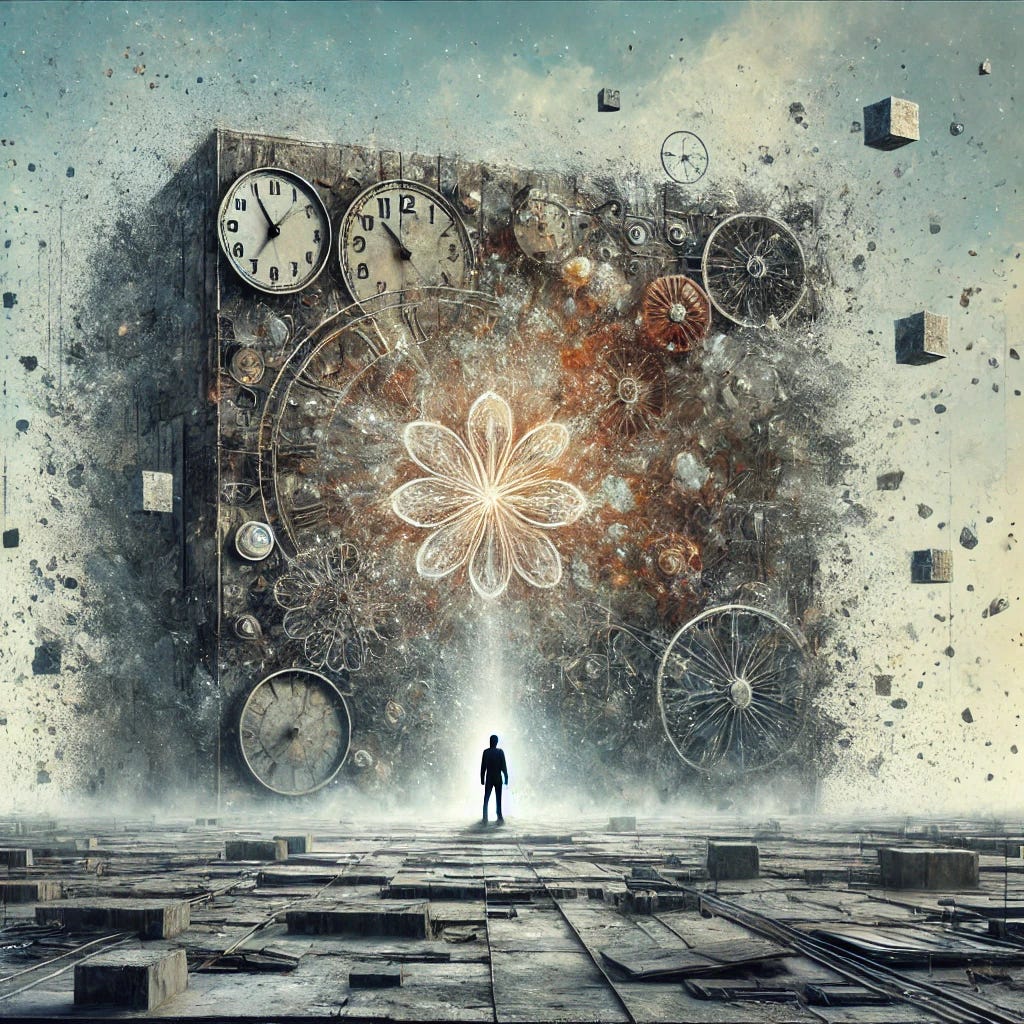
I will start in the middle. It’s a more honest place to begin since beginnings and endings serve only as bookends for what we think is important but can never tell the whole story. What story am I telling? The story of the middle. The story of Now.
Every exit is just an entrance somewhere else if Tom Stoppard is to be believed. I take that sentiment to heart. There is no origin, and there is no destination. There is only betweenness. What is this middle place called Now? What does it feel like? What is happening within and without as you read these words? That is the middle place, and that is where we live. For better or for worse, Now is home.
Humans are liminal creatures, always between one thing or another, usually on both sides of whatever they are busying themselves with, myself included in that description. We may view the Now as a space to move through, escaping the past as we run toward the future. However, it is more accurate to say that it is a place we walk around rather than through. In fact, it is everything because it is nothing. It is dynamically expansive because it is so fixedly limited. When we stay within the boundaries of this place called Now, we create infinite space within ourselves to receive all creation, ourselves included. But in this stillness of acceptance is an awareness of the true nature that we are always in movement, always in transition. So, how do we move within the Now? We dance.
Dancing is always in a relationship with space. How you dance is determined by the size and terrain of the stage. In becoming mindful of the space, we can surrender to the dancing. The dancer and the dance disappear. There is only dancing. We do not even realize this transition because there is no one there to realize it. We lose track of the noun version of ourselves and transform into the verb version. The distinction between self and action dissolves. I become being.
When this in-between space called Now feels very small, the dancing becomes very constricted. In fact, it may be so small that the dance feels like writhing in a coffin. We may find it very difficult to surrender to the dance in such a small space. The noun version of ourselves starts to experience many stories and gets lost in them. The verb version of ourselves gets forgotten and cannot flow. What is it that makes the Now small for us? We put up walls that keep us from the expansiveness of an otherwise infinite space. We are the masons; we are the bricklayers of our own mausoleum. Each brick and slab of mortar is made from our remembered past or our imagined future. In searching for a cask of amontillado to fill our glass, we seal our fate within the catacombs of our own minds. Then, how might we knock down these walls so that we may become this free and unhindered dancing?
Compassion is the acceptance of Now. When someone comes to us with a hard-luck story of pain and sorrow, it is not that person who experienced the story that we have compassion for; it is the person telling the story right now. It is the person who is sitting in front of us in this moment, in the shared space of Now that we feel for. We cannot do anything for that person who is living such a tragic past or a tragic future, but we might be able to do something for the person who is sitting with us today. Compassion is not a spectator sport. It is becoming intimately acquainted with the suffering that is happening now and entering into that story as an actor. It is using a map to find our way in an unfamiliar territory but not confusing the map for the territory. We remember to look up so that we may notice the trees, the rocks, the sky above us, and the earth underneath us because that is where we actually are. Otherwise, we may delude ourselves into believing that we are walking across a colorful piece of paper instead of a natural landscape. We may think we can do something for that person who experienced the suffering rather than the person who is suffering from the experience. This person may be us. We may be trying to help that version of ourselves who did not have the skills or capacity to dance at that moment or to accommodate the space they found themselves in. But in so doing, we build walls around ourselves and believe all that exists within these walls is all there is. We become the noun instead of the verb. I am the dancer instead of the dancing.
Compassion says, “Yes, there was a past,” and “Yes, there will be a future,” but I will never live there. They are not my home. They are like looking at pictures of some foreign land and believing that we are on the other side of the planet because of it. Compassion acknowledges the pictures but keeps us from falling into them. Compassion is the openness to our true home, to the Now that we embrace with a loving awareness of all that is here, even the pain. It is the dancing of an open heart whose tenderness is so sensitive that it feels for everything that it sees but is steadied by its awareness of the Now. It is a ballerina performing pirouettes whose orientation toward their own very human heart of now keeps them upright in a spinning world.
In the middle, we find the center. In the middle, we find ourselves. In the middle, we come home. Right now, you are in the middle. Right now, you are dancing.